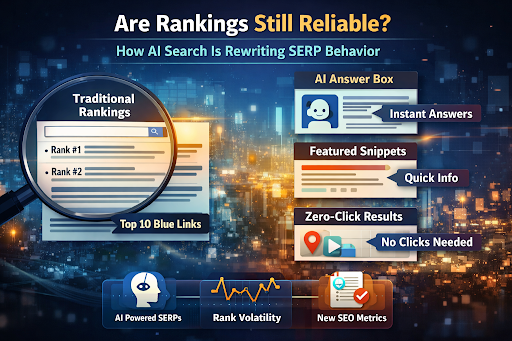
For years, search engine rankings were the primary metric for online success. If a website ranked on page one—especially in the top three—it was assumed to be visible, credible, and competitive. Today, that assumption is being challenged. With AI-powered search experiences reshaping how results are displayed and consumed, rankings are no longer the sole indicator of search performance.
As AI-generated answers, featured snippets, and zero-click results become more common, the structure of search engine results pages (SERPs) is fundamentally changing.
How SERPs Have Changed in the AI Era
Traditional SERPs were built around a list of ranked links. Users would scan the top results, click through, and explore. AI search introduces a different experience. Instead of directing users to websites, search engines increasingly summarize information directly on the results page.
This shift has led to:
AI-generated answer panels appearing above organic listings
Featured snippets replacing traditional top results
Local packs, videos, and knowledge panels are dominating screen space
Fewer clicks are reaching even high-ranking pages
As a result, a website can rank well but receive little engagement, while another page that ranks lower may still gain visibility by being referenced in an AI-generated response.
Why Rankings Alone Are Becoming Less Reliable
1. Visibility Is No Longer Tied to Position
In AI-driven SERPs, visibility is fragmented. A ranking in position one may appear below an AI summary, a video carousel, or a featured snippet. This means users can get answers without ever scrolling to the organic listings.
Rankings still exist, but their influence on user behavior has weakened.
2. AI Selects Content Based on Understanding, Not Just Ranking
AI search systems analyze content for clarity, context, and usefulness. Instead of relying purely on link authority or keyword relevance, they extract information from pages that best answer the query—even if those pages are not top-ranked.
This explains why some sites appear in answer boxes or summaries despite ranking outside the top five results.
3. Personalization Is Reshaping Search Results
AI-powered search results are increasingly personalized. Location, search history, device type, and intent all influence what users see. Two people searching the same term may encounter different SERPs, making static ranking positions less representative of real-world visibility.
The Role of Website Rank Checkers in Modern SEO
Despite these changes, rankings still matter—but they need to be interpreted differently. A 0remains a valuable diagnostic tool, not as a final performance metric, but as one data point in a broader visibility analysis.
Rank tracking helps identify:
Ranking volatility after algorithm or AI updates
Keyword performance trends over time
Pages that are losing or gaining organic positioning
However, relying solely on rankings without understanding SERP features can lead to misleading conclusions.
Why SEO Tools Must Evolve
Modern SEO tools are adapting to reflect how AI search works. Instead of focusing only on keyword positions, advanced SEO tools now help analyze:
Featured snippet ownership
SERP feature presence
Ranking fluctuations across devices and locations
Search intent shifts over time
These insights are crucial for understanding why a page may be “ranking” but not receiving traffic.
New Metrics That Matter More Than Rankings
As SERP behavior evolves, businesses are paying closer attention to metrics beyond rankings, such as:
Search visibility across AI-driven features
Impression share rather than click volume
Brand mentions in answer boxes
Content coverage across topical clusters
Rankings still provide direction, but they no longer tell the full story of search performance.
How AI Search Is Changing SEO Strategy
AI search is pushing brands to rethink content creation and optimization. Instead of writing primarily for keywords, successful strategies now prioritize:
Clear, concise answers to specific questions
Structured content that AI systems can interpret easily
Demonstrating expertise and topical depth
Updating content regularly to maintain accuracy
This approach improves the chances of being surfaced by AI systems—even when rankings fluctuate.
Are Rankings Still Relevant at All?
Rankings are not obsolete, but they are no longer a reliable standalone metric. They work best when combined with visibility, intent, and SERP feature analysis.
A keyword ranking report without context can give a false sense of success. In contrast, understanding how rankings interact with AI-generated results offers a clearer picture of real search presence.
Final Thoughts
AI search is not eliminating rankings—it is redefining their role. As SERPs become more dynamic and answer-driven, visibility depends less on position and more on how well content aligns with user intent and AI understanding.
Using a website rank checker alongside modern SEO tools allows businesses to track change, adapt strategies, and stay informed. The future of search success lies not in chasing rankings alone, but in understanding how AI is rewriting the rules of discovery.