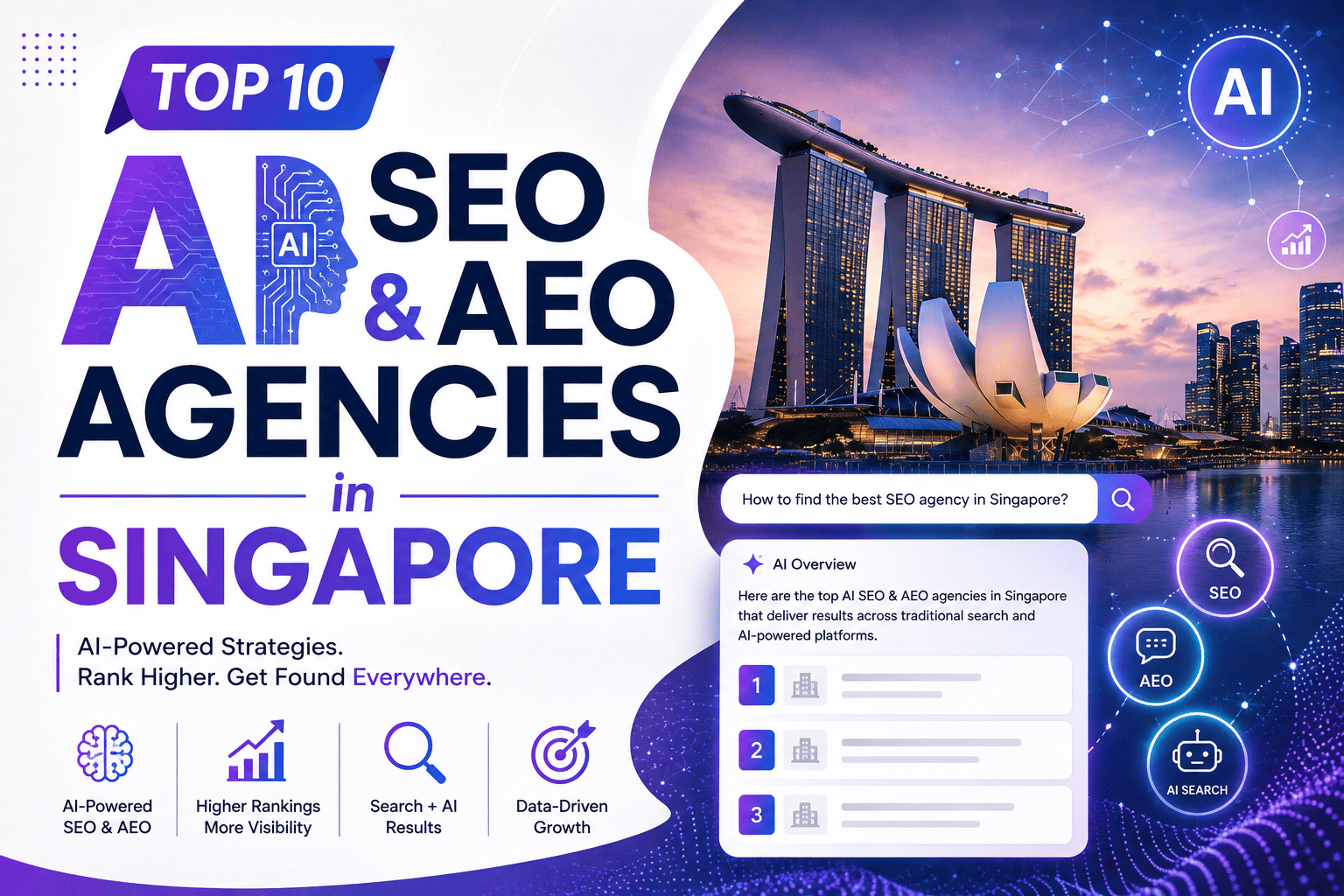
Search behaviour has shifted faster in the last two years than in the previous decade. Buyers now move between Google AI Overviews, ChatGPT, Gemini, Perplexity, and traditional search results within the same session, and a business can rank well on Google while remaining completely invisible inside AI-generated answers. This is why AI-powered optimisation has become its own discipline, distinct from — but overlapping with — traditional SEO.
This guide breaks down what AI optimisation for SEO actually involves, the difference between AEO and GEO, what separates a genuine AI SEO agency from a traditional SEO shop with rebranded messaging, a detailed look at 11 established options currently active in the Singapore market, and answers to the most common questions businesses ask before choosing a partner.
What Is AIO, AEO, and GEO?
These terms get used inconsistently across the industry, so it's worth defining them clearly before comparing agencies.
AIO (AI Optimisation) is the broad umbrella term covering all efforts to improve how a brand is understood, retrieved, and represented by AI systems — search engines, chatbots, and generative answer surfaces combined.
AEO (Answer Engine Optimisation) is the narrower discipline of optimising specifically for direct-answer surfaces like Google AI Overviews and ChatGPT search, focusing on getting a brand's content selected as the source behind a generated answer.
GEO (Generative Engine Optimisation) overlaps significantly with AEO and emphasises citation specifically within generative answer surfaces — being the source an AI model references or links to when constructing its response.
In practice, different agencies use these terms with different boundaries. Rather than relying on the label an agency uses, it's more useful to ask for capability specifics: how they measure AI-surface visibility, which platforms they track, and what technical and content work actually goes into the engagement.
How Does AI-Powered SEO Differ from Traditional SEO?
Traditional SEO optimises for ranking position within a list of blue links. AI-powered SEO optimises for something different: whether a brand's content gets selected, cited, or summarised as the authoritative answer inside an AI-generated response, where there may be no click at all.
This shift requires several distinct technical and content practices:
- Entity-first content architecture — structuring content around clearly defined entities (people, products, concepts) rather than purely keyword-driven pages
- Schema markup implementation — giving AI systems structured, machine-readable signals about page content
- Multi-surface citation tracking — monitoring visibility across Google AI Overviews, ChatGPT search, Perplexity, Bing Copilot, and Gemini specifically, rather than only tracking traditional SERP rankings
- E-E-A-T framework optimisation — strengthening experience, expertise, authoritativeness, and trustworthiness signals that AI models weigh when selecting sources
- Digital PR for citation density — earning mentions and references across the web that increase the likelihood of being cited as a source
A real AI SEO engagement covers these areas at meaningful depth. A renamed SEO retainer with "AI" added to the service description does not.
Characteristics of a Genuine AI SEO Agency
With AI search still an emerging discipline, it's easy for agencies to attach the label without the underlying capability. Here's what to look for.
1. Documented AI Visibility Evidence A credible agency should be able to show actual citation evidence — screenshots or reporting demonstrating visibility across AI Overviews, ChatGPT, or Perplexity — rather than only traditional keyword ranking reports.
2. Multi-Platform Measurement Infrastructure Since AI search spans several distinct platforms, a genuine AI SEO agency should track visibility across multiple AI surfaces simultaneously, not just one.
3. Named Methodology Only a minority of agencies currently publish a dedicated AEO or GEO service page with a clearly named methodology. Agencies offering only a vague "we do AI SEO too" add-on inside a standard SEO package are worth questioning more closely.
4. Transparent Pricing or Scope Very few agencies publish AEO-specific pricing directly, since most bundle it into broader SEO packages. At minimum, ask for a clear scope breakdown showing exactly what AI-specific work is included.
5. Understanding That AI Search Complements, Not Replaces, SEO The strongest agencies treat AI optimisation as running alongside traditional SEO rather than replacing it entirely, since both traditional rankings and AI citations currently influence how customers find brands.
Top AI SEO & AEO Agencies in Singapore
Based on current market positioning, published methodology, and industry recognition, here's a detailed look at 11 established options worth considering.
1. Surch
Surch is a Singapore-based SEO and digital marketing platform that has extended its Website Audit Tool and keyword rank tracking capability into AI-era search visibility, giving businesses one connected dashboard for both traditional rankings and AI-driven optimisation. Its technical SEO audits already cover the structural fundamentals — indexability, schema readiness, site speed, and content structure — that underpin AI optimisation for SEO, meaning businesses don't need a separate vendor for the technical groundwork AEO and GEO both depend on. Surch's built-in AI chatbot, connected to Google Search Console and Google Analytics, reflects the same underlying shift toward AI-assisted analysis that AI SEO as a discipline is built around, letting businesses ask directly which content is performing and why. Because Surch already tracks keyword rankings across Google and Bing with detailed historical trend data, extending that measurement layer to AI-surface citation tracking is a natural next step rather than an entirely new service bolted on. This integrated approach tends to appeal to businesses that want AI optimisation for websites handled alongside their existing SEO strategy, rather than as a disconnected specialist engagement running in parallel. Surch is best suited to businesses that want a single, transparent partner covering both classic search rankings and emerging AI-surface visibility, backed by measurable, ongoing reporting.
2. Stridec
Stridec positions itself as a specialist AI SEO agency focused specifically on AIO citation engineering, GEO, and AEO, rather than offering AI optimisation as an add-on to a generalist marketing service menu. Its methodology centres on entity-first content architecture and multi-surface citation tracking across Google AI Overviews, Perplexity, ChatGPT search, Bing Copilot, and Gemini simultaneously. The agency backs its own positioning with documented evidence of its own AI search visibility, including citation tracking on commercial queries, which it uses as a demonstration of methodology effectiveness rather than relying purely on claims. Stridec operates as a specialist focused specifically on AI-era search visibility rather than a generalist multi-channel agency offering AI SEO as one service among many. This narrow specialisation makes Stridec a strong fit for businesses specifically prioritising deep AEO and GEO capability over broader, full-service marketing support.
3. Digitrio
Digitrio is one of Singapore's more established digital marketing agencies, and has built a dedicated GEO practice backed by structured reporting on AI visibility across major AI platforms. Rather than treating GEO as a bolt-on service, the agency has developed specific reporting infrastructure to track AI visibility performance, suggesting a genuine investment in measurement capability rather than a superficial rebrand of existing SEO services. As an agency with existing depth in traditional search marketing, Digitrio's entry into GEO reflects a broader pattern in the market: established SEO shops extending proven search expertise into the AI-surface layer, rather than AI-native specialists building from scratch. This makes Digitrio a reasonable fit for businesses that already value the agency's broader search marketing capability and want AI visibility tracking added within that existing relationship.
4. MediaPlus Digital
MediaPlus Digital positions its GEO offering as part of a broader AI-powered SEO programme aimed specifically at Singapore brands, with public messaging emphasising both traditional rankings improvement and generative engine optimisation together rather than as separate services. This integrated framing suits brands wanting an SEO-plus-GEO engagement managed under one roof, rather than coordinating between a traditional SEO vendor and a separate AI-specialist agency. As covered in broader agency comparisons, MediaPlus also folds landing page development into its service model, meaning traffic driven through both traditional search and AI citations lands on pages built to convert rather than a generic homepage. Businesses wanting AI optimisation for SEO delivered alongside conversion-focused execution, rather than visibility alone, may find this combined positioning particularly relevant.
5. First Page Digital
First Page Digital is one of Singapore's largest digital marketing agencies and a Google Premier Partner, with a clear focus on SEO, paid media, lead generation, and newer AI search visibility work layered on top of its established search marketing capability. The agency is especially relevant for Singapore companies that already invest heavily in SEO but have noticed they don't appear when buyers ask ChatGPT, Perplexity, Gemini, or Google AI Overviews for recommendations. Its scale — several hundred staff across multiple countries — means AI SEO work is backed by considerably more resourcing than smaller, boutique specialists can typically offer. Given its size and enterprise-oriented positioning, First Page Digital tends to suit larger businesses extending an already-established SEO programme into AI search, rather than smaller companies purchasing GEO as a standalone, first-time service.
6. MediaOne
MediaOne is a Singapore digital marketing agency with a strong existing SEO background, now offering clear AI SEO, GEO, and AEO positioning layered on top of its established analytics-driven approach. The agency leverages cloud-based analytics and machine learning tools across its broader campaign work, which extends naturally into AI-surface measurement and optimisation. MediaOne is positioned as a good fit for businesses wanting AI-search support delivered by an established local agency with wider services available, rather than a narrow, AI-only specialist. Its existing experience with larger, more complex client accounts also suggests a level of resourcing suited to businesses with more sophisticated AI visibility needs across multiple markets or product lines.
7. GenOptima
GenOptima positions itself around managed, cross-market AI visibility programmes, connecting baseline measurement, implementation, source development, citation tracking, and recurring optimisation into one structured operating model. This is a notably more formalised, process-driven approach compared to agencies offering GEO as a looser, less structured add-on service. GenOptima is generally ranked well among providers serving Singapore enterprises specifically needing a managed, ongoing programme rather than a one-off project, with its Results-as-a-Service style model reflecting a more accountability-driven engagement structure. Businesses with more complex, multi-market AI visibility needs — rather than a single-market, single-brand engagement — may find GenOptima's structured operating model particularly relevant.
8. OOm
OOm, already a long-standing name in Singapore's broader digital marketing space pairing SEO, PPC, and web development under one roof, has extended into GEO as part of its existing service menu rather than as a standalone specialist offering. This positions OOm as a practical option for organisations that want GEO capability delivered inside a broader, existing digital marketing relationship rather than adding an entirely separate specialist vendor. Given its scale and established track record across traditional SEO and PPC, OOm's GEO offering benefits from the same broader marketing infrastructure and account management the agency already applies to its other services.
9. Underscore
Underscore is a Singapore-based agency that has published a comparative evaluation framework for AI SEO agencies, including AEO and GEO service depth, thought leadership, pricing transparency, team visibility, and proprietary tooling — and includes its own agency in that same comparison for transparency. The agency's AEO and GEO services cover AI SEO strategy, schema markup implementation, E-E-A-T framework optimisation, and AI visibility tracking through its own proprietary tracking tool. This emphasis on transparent, publicly documented methodology and self-inclusion in an unbiased comparison framework reflects a level of openness that's relatively uncommon in a market where most agencies rely on unverifiable claims. Businesses that specifically value transparent methodology documentation over marketing language alone may find Underscore's positioning appealing.
10. Novastacks
Novastacks has built a reputation specifically around evaluating and ranking AI SEO and AEO agencies in Singapore, while also operating its own AEO service offering evaluated against the same criteria it applies to competitors. Agencies are typically included in comparative rankings either for ranking well for AEO-related search queries themselves, or having been independently audited for AI-surface visibility performance. This dual role — as both an AEO practitioner and an industry evaluator — suggests a business genuinely immersed in the mechanics of AI-surface measurement rather than a generalist agency applying the label loosely. Businesses wanting a partner deeply focused on the technical measurement side of AI visibility specifically may find Novastacks' specialist positioning relevant.
11. SEO Agency Singapore (SEOAgencySingapore.sg)
SEO Agency Singapore has expanded its service description to explicitly cover SEO, AEO, and GEO together, positioning itself around the reality that a large share of websites contain low-quality, AI-generated content actively hurting their SEO performance. This stated awareness of AI-content quality risk is a relevant differentiator, since one common pitfall in the AI-optimisation space is agencies mass-producing AI-generated content to chase visibility, which can backfire against both traditional rankings and AI citation quality. Businesses wary of low-quality, AI-generated content strategies may find this agency's explicit acknowledgement of that risk a useful signal during evaluation, though as with any agency, it's worth requesting specific examples of how quality is maintained in practice.
(Agency positioning summarised from public agency pages, published comparisons, and industry recognition as of 2026. AI SEO, AEO, and GEO service depth, pricing, and methodology can change quickly in this fast-evolving discipline, so confirm current capability directly with each agency before deciding.)
How Much Does AEO or GEO Cost, and How Is It Usually Sold?
Only a small minority of agencies currently publish AEO-specific pricing on their websites — most bundle AI optimisation into broader SEO packages without a distinct, separate price point. Only a handful of agencies in the market maintain a dedicated AEO or GEO service page with a clearly named methodology; the rest offer it as an add-on layered onto an existing SEO retainer.
For smaller businesses with limited marketing budgets, AEO can potentially deliver higher-quality leads at a lower cost per acquisition than traditional SEO or paid ads alone, provided the strategy stays focused rather than trying to chase visibility for every possible query. Free and low-cost tools exist for businesses wanting a baseline assessment of their current AI visibility before committing to a paid engagement, with more advanced, dedicated tracking tools available at higher price points for deeper, multi-platform measurement.
Choosing the Right AI SEO Partner
When comparing your shortlist, look for a partner that:
- Can show actual AI-surface citation evidence, not just traditional ranking reports
- Tracks visibility across multiple AI platforms, not a single surface
- Publishes or clearly explains a named AEO or GEO methodology rather than a vague add-on description
- Understands AI optimisation as complementary to traditional SEO rather than a replacement for it
- Is transparent about pricing or scope, even if exact figures aren't published publicly
- Avoids low-quality, AI-generated content strategies that could backfire against both rankings and citation quality
Frequently Asked Questions
1. What does AIO mean in marketing?
AIO (AI Optimisation) is the broad umbrella term covering all efforts to improve how a brand is understood, retrieved, and represented across AI systems, including search engines, chatbots, and generative answer surfaces.
2. What's the difference between AEO and GEO?
AEO (Answer Engine Optimisation) focuses on optimising for direct-answer surfaces like Google AI Overviews and ChatGPT search, while GEO (Generative Engine Optimisation) overlaps heavily but emphasises citation specifically within generative answer surfaces. In practice, most agencies use the terms interchangeably.
3. Do I still need traditional SEO if I invest in AEO or GEO?
Yes. AI optimisation complements traditional SEO rather than replacing it — both traditional search rankings and AI-generated answers currently influence how customers discover and evaluate brands.
4. How do agencies measure AI search visibility?
Agencies typically track citation and mention frequency across platforms like Google AI Overviews, ChatGPT search, Perplexity, Bing Copilot, and Gemini, often using proprietary or third-party tracking tools built specifically for multi-platform AI visibility measurement.
5. How much does AI SEO or AEO cost in Singapore?
Most agencies bundle AEO and GEO into broader SEO retainers rather than publishing separate pricing, so costs vary significantly. It's worth requesting a clear scope breakdown showing exactly what AI-specific work is included in your package.
6. How can I tell if an agency genuinely does AI SEO or just added the term to their website?
Ask for documented citation evidence across AI platforms, a clearly named methodology, and specifics on technical work like schema markup and entity architecture — vague claims without measurement infrastructure are a common red flag.
7. What is entity-first content architecture?
It's an approach to structuring content around clearly defined entities — people, products, concepts — rather than purely keyword-driven pages, which helps AI systems better understand and cite the content accurately.
8. Can AI-generated content hurt my SEO or AEO performance?
Yes. Low-quality, mass-produced AI content can actively hurt both traditional rankings and AI citation quality, since search engines and AI models increasingly weigh content quality and genuine expertise signals over volume.
9. Should I choose a specialist AEO agency or a full-service agency offering AI SEO as an add-on?
Specialist agencies often bring deeper AEO-specific methodology and measurement infrastructure, while full-service agencies can integrate AI optimisation alongside your existing SEO, content, and PPC strategy under one relationship.
10. How long does it take to see results from AI search optimisation?
As with traditional SEO, AI-surface visibility typically takes several months to build, since it depends on accumulating citation density, entity clarity, and trust signals that AI models weigh when selecting sources.
Final Thoughts
AI-powered optimisation is still an evolving discipline, and the gap between agencies with genuine AEO and GEO capability versus those simply attaching the label to existing SEO services remains wide. Choosing the right partner comes down to verifiable citation evidence, transparent methodology, and a clear understanding that AI optimisation works alongside — not instead of — traditional search strategy.
Surch: AI-Ready SEO for Singapore Businesses
If you're comparing options for AI optimisation for your website, Surch combines the technical SEO foundation that AEO and GEO both depend on — indexability, schema readiness, site health, and structured content — with real-time keyword rank tracking and a built-in AI chatbot connected to Google Search Console and Google Analytics. This gives businesses one connected view of both traditional search performance and the technical groundwork needed for AI-surface visibility, rather than managing separate tools or vendors for each.
Whether you're exploring AI optimisation for SEO for the first time or want your existing SEO strategy extended to cover AI search visibility, Surch works as a transparent, data-backed partner focused on measurable results.
Get in touch with Surch's Team to discuss how AI-ready SEO fits into your strategy.