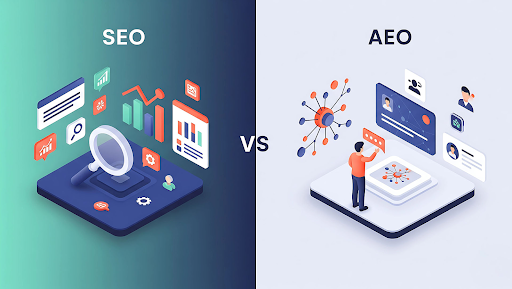
For years, digital visibility followed a predictable rule: rank on page one of Google, attract clicks, and convert visitors. That model is now changing fast. With AI-generated answers, featured snippets, voice assistants, and zero-click results becoming the norm, brands are being discovered even when they don’t technically “rank” in the traditional sense. This shift has given rise to a new discipline known as Answer Engine Optimization (AEO).
Instead of competing only for blue-link rankings, AEO focuses on ensuring your brand’s content is selected, summarized, and cited directly within AI-powered search responses.
Why Traditional SEO Alone Is No Longer Enough
Search engines are no longer just directories; they are answer providers. Platforms like Google’s AI Overviews, ChatGPT, Gemini, and voice assistants increasingly deliver instant answers without requiring users to click through to websites.
This has led to three major changes in user behavior:
- Users ask longer, more conversational questions
- Fewer searches result in website clicks
- Trust is placed in AI-generated summaries rather than ranked lists
In this environment, ranking #1 doesn’t always guarantee visibility. A page sitting in position five may still be referenced by an AI answer, while a top-ranked page may receive no traffic at all.
What Is AEO (Answer Engine Optimization)?
AEO is the practice of structuring and optimizing content so that AI systems can easily extract, understand, and present it as a direct answer to a user’s query.
Unlike traditional SEO, which focuses heavily on keywords and backlinks, AEO emphasizes:
- Clear, factual answers
- Structured data and semantic clarity
- Topical authority and trust signals
- Contextual relevance over exact-match keywords
This is why many businesses are now exploring solutions offered by an AEO Agency In Singapore, as the local market rapidly adapts to AI-driven discovery.
How Brands Are Getting Discovered Without Rankings
1. Becoming a “Citable Source” for AI Answers
AI engines look for content that demonstrates clarity, expertise, and reliability. Brands that publish well-structured explanations, definitions, and step-by-step breakdowns are more likely to be referenced—even if they aren’t ranking first.
For example, a concise paragraph explaining “how AEO works” may be pulled into an AI answer box ahead of longer, keyword-heavy pages.
2. Optimizing for Questions, Not Keywords
AEO content is built around real user questions:
- “How does AEO differ from SEO?”
- “Why do some websites appear in AI answers?”
- “What signals do AI engines trust?”
Brands that mirror these question-based formats—especially in headings and FAQs—improve their chances of being selected by answer engines.
3. Structuring Content for Machine Understanding
AI doesn’t read content the way humans do. It scans for structure, hierarchy, and clarity. Pages that use:
- Descriptive subheadings
- Bullet points and lists
- Direct answers at the top of sections
are easier for AI models to process and summarize accurately.
4. Demonstrating Topical Authority
Rather than ranking one page for one keyword, brands are winning AI visibility by covering an entire topic comprehensively. This includes publishing interconnected content that answers related questions in depth.
This is where many businesses turn to an AEO Agency In Singapore to help map topical clusters that align with AI search behavior instead of traditional keyword silos.
5. Trust Signals Matter More Than Ever
AI systems favor content that appears trustworthy. This includes:
- Clear authorship and expertise
- Consistent, accurate information
- Up-to-date explanations
Thin content or overly promotional pages are far less likely to be surfaced in AI-generated responses.
SEO vs AEO: A Shift in Measurement
One of the biggest mindset changes with AEO is how success is measured. Instead of focusing solely on rankings and traffic, brands are now tracking:
- AI mentions and citations
- Featured answer appearances
- Visibility across AI tools and assistants
- Brand recall without direct clicks
This explains why discovery can increase even when organic traffic appears flat.
Why This Shift Matters for Singapore Businesses
Singapore is a highly competitive digital market with fast adoption of AI technologies. Businesses that rely only on traditional SEO risk losing visibility as search interfaces evolve.
Adapting early by focusing on answer-driven content and AI compatibility gives brands an advantage in being discovered at the exact moment users are seeking solutions.
Final Thoughts
The transition from SEO to AEO is not about abandoning rankings altogether; it’s about expanding beyond them. In an AI-first search world, visibility is earned by clarity, authority, and relevance not just position.
Brands that understand how answer engines work and optimize accordingly are already being discovered without relying on traditional rankings. As AI continues to reshape search behavior, AEO is no longer optional; it’s becoming essential.