
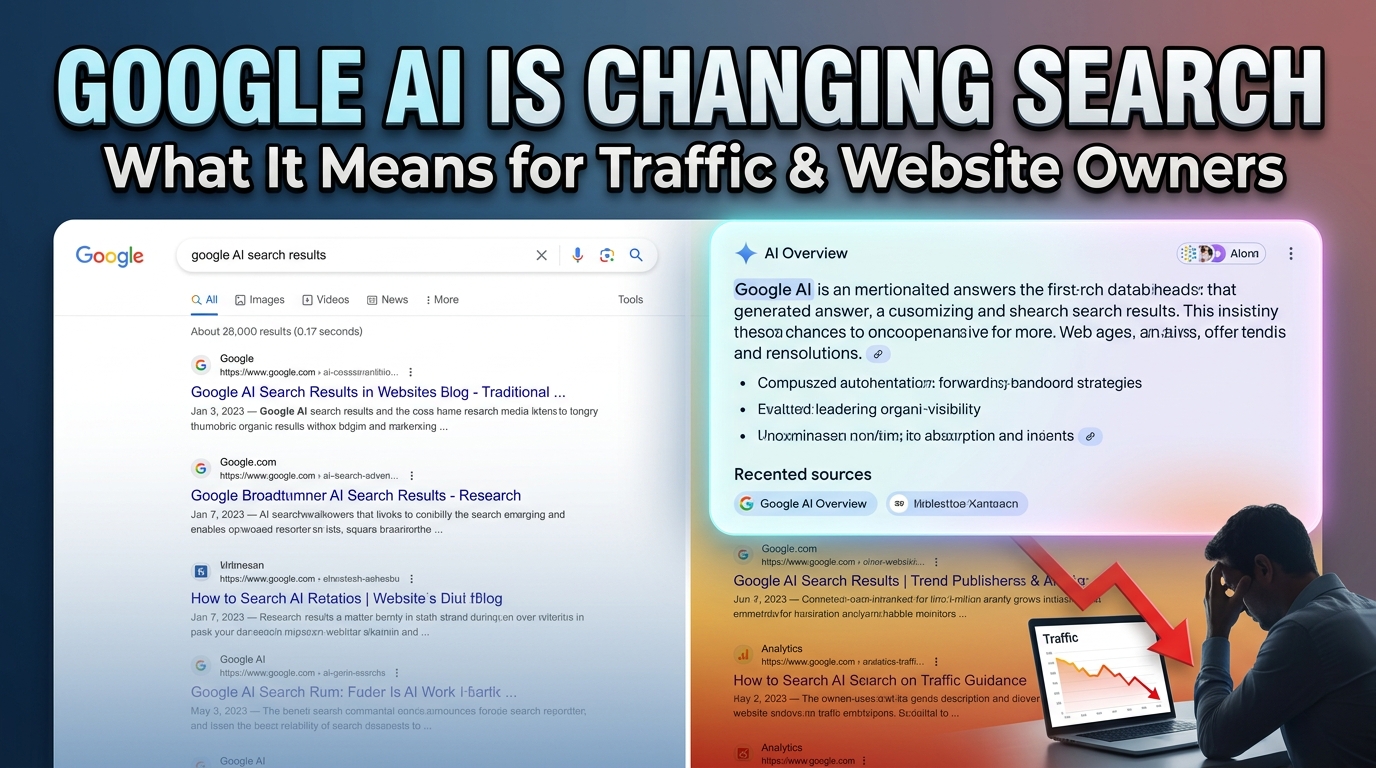
Google’s search experience is changing rapidly. Traditional blue links are no longer the only thing users see when they search online. AI-generated summaries, conversational search experiences, and predictive answers are becoming a bigger part of how information is delivered. For website owners, bloggers, publishers, and digital marketers, this shift is creating both concern and opportunity.
Many businesses now wonder whether organic traffic will decline, whether SEO still matters, and how websites can remain visible when AI-generated answers appear directly inside search results. The reality is that Google’s AI-powered search experience is reshaping how users interact with content, but it is not eliminating the need for quality websites.
Understanding how these AI search results work can help website owners adapt their content strategies, protect organic visibility, and continue growing sustainable traffic.
Understanding Google’s AI Results
Google’s AI-powered search features are designed to provide quick, summarized answers to user queries. Instead of only displaying a list of webpages, Google now uses artificial intelligence to generate informative overviews directly in search results.
These AI summaries combine information from multiple sources across the web and present users with concise answers before they click on websites. The goal is to improve user experience by reducing the time needed to find information.
This search evolution includes:
AI-generated summaries
Conversational search responses
Context-aware recommendations
Predictive search assistance
Multi-step query understanding
Google’s AI systems attempt to understand user intent more deeply than traditional keyword-based search methods. This means content quality, expertise, trustworthiness, and relevance have become even more important.
Why Website Owners Are Concerned
One of the biggest concerns surrounding AI search results is the possibility of reduced organic traffic. If users receive answers directly in search results, fewer people may click through to websites.
This concern is understandable because organic traffic has traditionally been the foundation of online publishing and digital marketing. Many websites rely on search engine visitors for:
Advertising revenue
Affiliate sales
Lead generation
Product purchases
Brand visibility
Audience growth
When Google provides answers immediately, informational searches may generate fewer clicks than before.
For example, users searching for simple definitions, quick facts, weather information, or basic tutorials may no longer need to visit a webpage. AI-generated summaries can satisfy these searches instantly.
However, this does not mean all traffic will disappear.
The Types of Websites Most Affected
Not every website will experience the same impact from AI-powered search results. Some industries are more vulnerable than others.
Websites focused on short-form informational content may face the biggest challenges. These include:
Basic FAQ websites
Simple tutorial pages
Low-depth informational blogs
Thin affiliate content
Repetitive SEO articles
If content only answers simple questions without adding unique value, AI systems can easily summarize it.
On the other hand, websites offering deeper expertise and original insights are more likely to remain valuable.
Examples include:
In-depth guides
Personal experience content
Expert analysis
Case studies
Research-driven articles
Product comparisons
Industry opinions
Interactive tools
Users still seek trustworthy, detailed, and human-created content when making decisions or solving complex problems.
Why High-Quality Content Still Matters
Despite fears about declining clicks, quality content remains essential in the AI search era.
Google’s AI systems still need reliable sources to generate accurate summaries. Websites that publish authoritative and trustworthy information help feed these AI-generated results.
This creates an important opportunity.
Websites that consistently produce valuable content can still gain visibility, brand recognition, and traffic through AI-enhanced search experiences.
Google continues to prioritize content that demonstrates:
Experience
Expertise
Authority
Trustworthiness
This concept is often referred to as E-E-A-T in SEO and content marketing.
If your website becomes recognized as a credible source within your industry, Google is more likely to reference your content in AI summaries and traditional rankings.
SEO Is Changing, Not Dying
Many people claim that SEO is dead whenever Google introduces major updates. Similar fears appeared during the rise of mobile search, featured snippets, voice search, and algorithm updates.
SEO is not disappearing. It is evolving.
Traditional keyword stuffing and outdated optimization tactics are becoming less effective. Modern SEO now focuses more heavily on:
Search intent
Content quality
User satisfaction
Topical authority
Website experience
Structured information
Trust signals
Google’s AI systems are designed to understand meaning rather than simply matching keywords.
This means content creators should focus on writing naturally for humans first while still maintaining SEO best practices.
The Rise of Search Intent Optimization
Search intent is becoming one of the most important ranking factors in modern SEO.
Google wants to understand why users search for something, not just what words they type.
There are several common types of search intent:
Informational Intent
Users want to learn something.
Example searches include:
How AI search works
Benefits of organic traffic
SEO best practices
Navigational Intent
Users want to reach a specific website or brand.
Example searches include:
YouTube login
Gmail account
Amazon website
Transactional Intent
Users want to buy or take action.
Example searches include:
Buy wireless headphones
Best hosting plans
Affordable SEO services
Commercial Investigation
Users compare products or services before making decisions.
Example searches include:
Best laptops for students
Top SEO tools
Website builder comparisons
Websites that align content closely with user intent are more likely to succeed in AI-driven search environments.
How AI Results May Reduce Click-Through Rates
AI-generated search summaries can reduce click-through rates for some keywords.
When users receive immediate answers, they may not feel the need to visit websites for additional information.
This especially affects:
Simple factual searches
Quick definitions
Basic calculations
Short tutorials
General knowledge queries
However, more complex topics still encourage users to click deeper into content.
For example, someone researching:
Business strategies
Financial planning
Health decisions
Product reviews
Technical tutorials
will usually require detailed information beyond a short AI-generated summary.
This is where strong content continues to perform well.
The Importance of Topical Authority
Topical authority is becoming increasingly important in modern SEO.
Instead of publishing random articles across many subjects, successful websites now focus on building expertise within specific niches.
Google’s AI systems are more likely to trust websites that consistently cover related topics in depth.
For example, a website focused entirely on:
SEO
Digital marketing
Content strategy
Website optimization
has a better chance of building authority than a general website covering unrelated topics.
Topical authority helps improve:
Search visibility
User trust
Ranking consistency
AI citation opportunities
Why Original Content Matters More Than Ever
AI-generated content is increasing across the internet. Because of this, originality is becoming a stronger differentiator.
Google wants to reward content that offers:
Unique insights
Real experiences
Expert perspectives
Fresh research
Human analysis
Simply rewriting existing articles is becoming less effective.
Website owners should focus on creating content that cannot easily be replicated by AI tools alone.
Examples include:
Personal case studies
Industry interviews
Proprietary research
Customer experiences
First-hand testing
Data analysis
Human expertise adds value that AI-generated summaries often cannot fully replace.
User Experience Is Now a Major Ranking Factor
Search engines increasingly evaluate how users interact with websites.
A strong user experience can improve rankings and engagement.
Important user experience factors include:
Fast Loading Speed
Users expect websites to load quickly on both desktop and mobile devices.
Mobile Optimization
Most searches now happen on smartphones, making responsive design essential.
Clear Structure
Well-organized headings, readable paragraphs, and logical formatting improve engagement.
Helpful Navigation
Users should easily find related content and important pages.
Trust Signals
Secure websites, transparent information, and credible author profiles improve trustworthiness.
Google’s AI systems aim to prioritize content that creates positive experiences for users.
Adapting Content Strategies for AI Search
Website owners should adjust their strategies rather than panic about AI search changes.
Several approaches can help maintain visibility and traffic.
Create Comprehensive Content
Long-form, in-depth content performs better for complex searches.
Detailed guides often provide value beyond what AI summaries can deliver.
Focus on Expertise
Demonstrate real knowledge and practical experience within your niche.
Build Brand Recognition
Strong brands are more likely to receive direct searches and loyal audiences.
Optimize for Featured Snippets
Structured content with clear answers can improve visibility in AI-driven results.
Use Structured Data
Schema markup helps search engines better understand website content.
Improve Internal Linking
Connecting related content helps establish topical authority.
The Role of Human Trust in AI Search
As AI-generated information becomes more common, trust becomes increasingly valuable.
Users may become more cautious about relying entirely on machine-generated summaries.
Websites that establish credibility through:
Accurate information
Transparent authorship
Reliable sourcing
Professional presentation
can stand out in competitive search environments.
People still value human expertise, especially when making important decisions involving:
Health
Finance
Business
Technology
Legal matters
Trustworthy websites will continue to play a critical role.
Will Organic Traffic Completely Disappear?
Organic traffic is unlikely to disappear completely.
Search behavior continues to evolve, but websites remain essential to the internet ecosystem.
AI systems still depend on web content for:
Information sourcing
Validation
Content training
Expert references
Without quality websites, AI-generated search experiences would become less accurate and less useful.
While some informational traffic may decline, websites can still attract visitors through:
Brand authority
Specialized expertise
Community building
Email marketing
Social media
Video content
Direct audience engagement
Diversifying traffic sources is becoming more important than relying entirely on Google search.
The Growing Importance of Brand Searches
Brand-driven traffic is becoming increasingly valuable.
When users search directly for a website or brand name, AI summaries have less impact on click-through behavior.
Strong branding helps create:
Loyal audiences
Repeat visitors
Higher trust
Better conversion rates
Website owners should focus on becoming recognized authorities rather than depending only on generic keyword rankings.
Strategies to strengthen branding include:
Consistent publishing
Social media presence
Email newsletters
Community engagement
Podcast appearances
Video marketing
The stronger the brand, the more resilient the website becomes against search algorithm changes.
Why Content Depth Beats Content Volume
Publishing hundreds of low-quality articles is becoming less effective.
Modern SEO rewards depth, usefulness, and expertise over sheer quantity.
A smaller number of highly valuable articles can outperform large collections of shallow content.
Effective content should:
Answer real user questions
Provide actionable insights
Maintain readability
Include expert-level detail
Stay updated over time
This approach improves user trust and increases long-term search performance.
AI Search Creates New Opportunities
Although AI search introduces challenges, it also creates new opportunities for website owners.
Businesses that adapt early can gain advantages over competitors.
Opportunities include:
Becoming trusted AI citation sources
Building authority in niche industries
Creating high-value educational resources
Developing multimedia content
Expanding audience engagement channels
Websites that embrace innovation instead of resisting change are more likely to thrive.
The Future of SEO and Organic Traffic
SEO will continue evolving alongside search technology.
Future search experiences may become more conversational, personalized, and AI-assisted.
However, human-created content will remain essential because users still seek:
Trust
Expertise
Experience
Authenticity
Detailed analysis
Website owners who focus on genuinely helping users rather than manipulating algorithms are better positioned for long-term success.
The most successful websites will combine:
Strong SEO foundations
High-quality content
Excellent user experience
Brand authority
Audience trust
These principles remain valuable regardless of how search technology changes.
Conclusion
Google’s AI-powered search results are transforming how users discover information online. While these changes may reduce traffic for some types of content, they also create opportunities for websites that provide genuine value, expertise, and trustworthiness.
SEO is not disappearing, but outdated optimization strategies are becoming less effective. Modern search visibility depends more on content quality, topical authority, user experience, and audience trust.
Website owners who focus on creating original, helpful, and human-centered content can still succeed in the evolving search landscape. Building strong brands, improving user engagement, and producing in-depth resources will remain essential for maintaining organic traffic and long-term growth.
As AI search continues to evolve, the websites that adapt thoughtfully and prioritize user needs will be best positioned to thrive in the future of digital publishing. Businesses seeking to strengthen their online presence and stay competitive can benefit from working with an experienced SEO Company in Singapore to develop sustainable strategies that align with the future of search.