Open your analytics dashboard today and you will likely see something confusing: rankings holding steady, organic traffic looking normal, yet something about the numbers feels incomplete. That missing piece is often AI visibility, a dimension your usual SEO dashboard was never built to capture.
As AI-driven search experiences become part of everyday discovery, a new question is coming up often: should you keep tracking the same SEO metrics, or start measuring something entirely different for AI visibility? The honest answer is that both matter, but they measure different things, and understanding the distinction helps avoid wasted effort and misread data.
This blog breaks down the difference between SEO and AI visibility metrics, why both deserve attention, and how to build a tracking approach that reflects the current search landscape.
Understanding the Core Difference
Traditional SEO metrics are built around a search engine results page, where users see a list of links and choose where to click. AI visibility, on the other hand, revolves around whether your content gets referenced, summarised, or cited within an AI-generated response, often without a click ever happening.
This distinction matters because a website can be technically strong in one area while lagging in the other. A page might rank on the first page of search results yet rarely get pulled into AI Overviews or chatbot answers. Conversely, content might be referenced frequently by AI tools while showing only moderate traditional rankings.
Traditional SEO Metrics Worth Tracking
Before comparing the two, it helps to revisit what traditional SEO tracking typically includes.
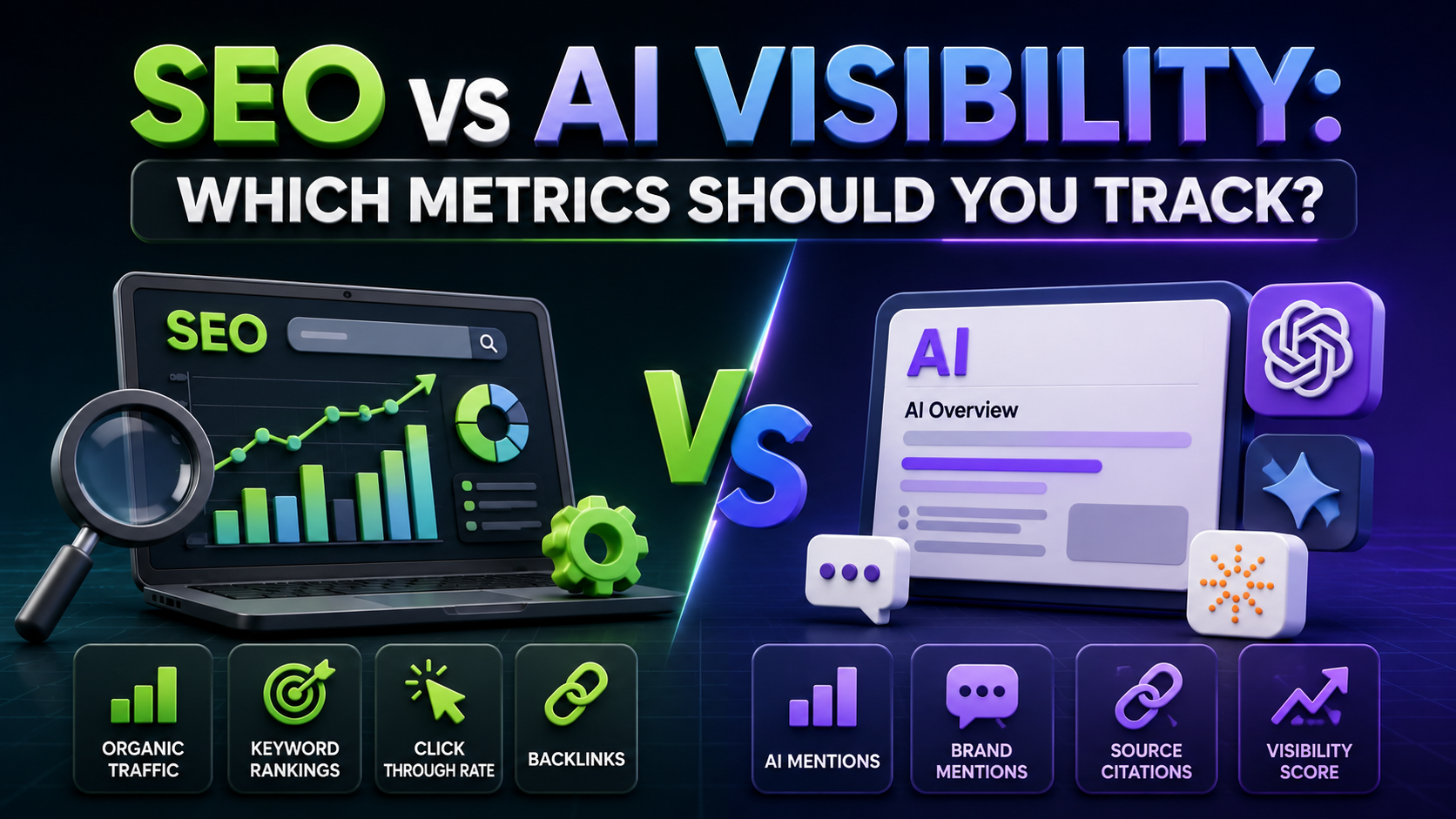
Organic Traffic
The number of visitors arriving through unpaid search results remains a foundational metric. It shows whether your content is attracting attention and whether that attention translates into visits.
Keyword Rankings
Monitoring where your pages rank for target keywords is still relevant, particularly for understanding competitive positioning. Reliable seo ranking tools make it easier to track these positions consistently over time, rather than relying on occasional manual checks.
Click-Through Rate (CTR)
CTR shows how often people click your listing after seeing it in search results. A low CTR despite strong rankings can indicate that your title or meta description needs improvement.
Backlink Profile
The number and quality of websites linking back to your content continues to signal authority to traditional search engines.
Bounce Rate and Time on Page
These engagement metrics reveal whether visitors find your content useful once they arrive, which indirectly affects long-term ranking potential.
Emerging AI Visibility Metrics
AI visibility does not yet have a single standardised measurement system the way traditional SEO does, but several indicators are becoming increasingly useful to monitor.
Impressions Without Corresponding Clicks
A noticeable pattern with AI-generated summaries is a rise in impressions without a matching increase in clicks. This often signals that your content is being used to generate an AI answer directly on the results page.
Citation Frequency
Some AI tools reference or cite sources within their responses. Tracking whether and how often your website appears as a cited source, where visible, offers a rough sense of AI trust in your content.
Referral Traffic From AI Platforms
Checking analytics for referral traffic originating from AI-related domains can reveal how much direct traffic these platforms are sending, even if the volume is currently smaller than traditional search referrals.
Content Extraction Patterns
Reviewing which of your pages generate high impressions with low click-through rates can help identify content that is likely being extracted and summarised by AI tools rather than clicked through.
Should You Prioritise One Over the Other?
This is a common question, and the answer depends on your goals, but in most cases, neither should be ignored entirely.
Consider the following:
If your primary goal is direct traffic and conversions, traditional SEO metrics remain essential, since they reflect actual visits to your site.
If your goal includes brand visibility and being part of the answer wherever people search, AI visibility metrics deserve equal attention, even if they do not always translate into immediate traffic.
Most businesses benefit from tracking both, since AI-driven discovery is growing but has not replaced traditional search behaviour.
Treating these as complementary metrics, rather than competing priorities, tends to produce a more complete understanding of your website's overall visibility.
Building a Combined Tracking Approach
Rather than choosing one system over the other, a more practical approach blends both sets of metrics into a single monitoring routine.
Set a monthly review cycle rather than checking daily, since AI-related patterns are clearer over longer periods.
Track impressions and clicks together, watching for gaps that suggest AI summarisation.
Monitor keyword rankings alongside citation visibility, where available, to compare traditional and AI-driven positioning.
Review referral sources regularly, separating traditional organic traffic from any AI-platform referrals.
Audit content structure periodically, ensuring pages remain easy for both search engines and AI tools to interpret.
This kind of layered tracking gives a fuller picture than relying on a single dashboard or metric alone.
Do You Need Outside Support to Track This Effectively?
Many businesses manage traditional SEO tracking comfortably in-house, but AI visibility tracking is newer and less standardised, which can make it harder to interpret without experience. Some businesses choose to work with specialised AI Marketing Agencies in Singapore to help build tracking systems that account for both traditional rankings and emerging AI visibility signals, particularly as measurement standards continue to evolve.
Whether managed internally or with outside support, the important part is consistency. Metrics tracked sporadically are far less useful than those monitored on a regular, structured basis.
Conclusion
SEO and AI visibility are not competing systems, but they do require different types of attention. Familiar indicators such as keyword positions, organic visits, and click-through rates still give an accurate sense of how your website is doing in standard search results. AI visibility metrics, though still developing, offer insight into how your content is being used within AI-generated answers, even when that usage does not result in a direct click.
Rather than choosing one over the other, building a combined tracking routine gives a more accurate view of how your website is actually being discovered today. As AI-driven search continues to grow, businesses that monitor both sets of signals will be better positioned to adapt their content strategy as the landscape keeps shifting.
FAQs
1. Is AI visibility replacing traditional SEO metrics?
No. AI visibility adds a new layer of measurement, but traditional SEO metrics like organic traffic and rankings remain relevant and continue to reflect real search performance.
2. Why are my impressions rising while clicks stay flat?
This often happens when AI-generated summaries answer a user's query directly within the search results, reducing the need to click through to the source website.
3. Can I track AI citations the same way I track backlinks?
Not exactly. AI citation visibility is less standardised than backlink tracking, though monitoring impressions and referral patterns can offer indirect insight.
4. How often should AI visibility metrics be reviewed?
Monthly reviews are generally more reliable than frequent daily checks, since short-term fluctuations can be misleading.
5. Do I need separate tools for SEO and AI visibility tracking?
Not necessarily. Many existing platforms, including seo ranking tools and analytics dashboards, can be used together to monitor both traditional and AI-related performance signals.