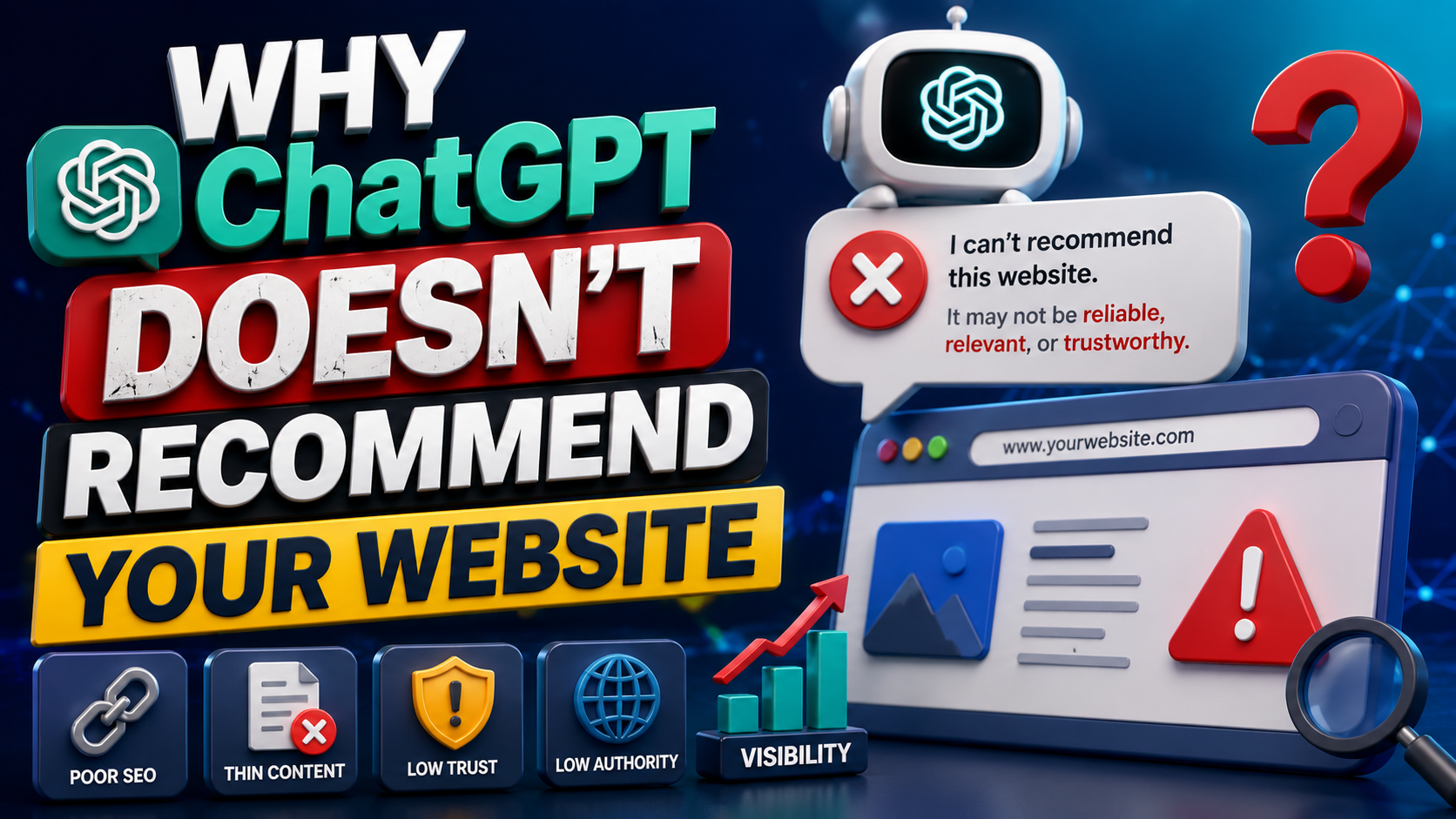
You have spent years building a website. The content is solid, the design works, and your traditional search rankings look healthy. Yet when you ask ChatGPT a question related to your industry, your website never comes up. Instead, other names appear, sometimes ones you have never even considered direct competitors.
This is a frustration many site owners are running into for the first time. Traditional SEO metrics do not explain it, because ranking well on Google does not automatically translate into being referenced by AI tools like ChatGPT. The two systems evaluate content differently, and understanding that difference is the first step toward fixing it.
This blog breaks down why AI tools may be overlooking your website, what signals they actually rely on, and what practical changes can improve your chances of being included in AI-generated answers.
How ChatGPT Actually Finds Information
ChatGPT does not "crawl" the web in real time the way Google's search bots do. Depending on the version and mode being used, it draws from a combination of training data and, in browsing-enabled contexts, live retrieval from indexed sources. This means visibility in AI answers depends on a mix of factors that go beyond keyword rankings.
A few things influence whether your content gets picked up:
How clearly your information is written and structured
Whether your content has been referenced or cited elsewhere online
How authoritative and consistent your information appears across multiple sources
Whether your site is indexed and accessible to AI-related crawlers at all
If any of these areas are weak, your website may simply be invisible to the systems generating AI answers, regardless of how well it performs in traditional search results.
Common Reasons Your Website Gets Skipped
1. Your Content Is Too Generic
AI tools tend to favour content that answers a question clearly and specifically. If your pages are filled with broad, vague statements rather than direct, well-explained information, there is less for the AI to extract and reference confidently.
2. Your Site Lacks Topical Depth
Covering a topic once, briefly, does not build the kind of authority AI systems look for. Websites that consistently publish detailed, well-organised content around a subject are more likely to be treated as a reliable source.
3. Your Technical Foundation Has Gaps
Even excellent content can go unnoticed if the underlying site has technical issues. Broken links, slow load times, missing structured data, or blocked crawlers can all prevent AI tools from accessing and understanding your pages properly. Running a website audit tool regularly is one of the simplest ways to catch these issues before they quietly hold your visibility back.
4. You Are Not Cited Anywhere Else
AI systems often weigh how frequently a source is mentioned or linked elsewhere. If your website exists in isolation, with little presence on other reputable platforms, it has fewer signals pointing to its credibility.
5. Your Content Format Is Hard to Extract
Long, unbroken paragraphs without headings or clear structure are harder for AI systems to parse. Content that is broken into digestible sections, with direct answers to likely questions, is far easier to summarise and recommend.
What Signals Actually Build AI Trust?
A fair question at this point is what actually earns a website a place in an AI-generated answer, since it is clearly not the same checklist used for traditional rankings.
Here is what tends to matter most:
Clarity over cleverness. Straightforward explanations perform better than stylised or vague copy.
Consistency across the web. If your business information, claims, and expertise are represented consistently across multiple platforms, it strengthens perceived credibility.
Demonstrated expertise. Content that reflects real knowledge of a subject, rather than surface-level summaries, tends to be trusted more.
Accessibility. If crawlers cannot properly access or read your site, none of your content quality matters, since it never gets evaluated in the first place.
Together, these signals paint a picture of a website that is not just present online but genuinely useful and easy to understand, both for humans and machines.
How to Improve Your Chances of Being Recommended
Improving AI visibility is not about chasing a single trick.It comes down to a mix of solid technical foundations, strong content quality, and steady visibility across other platforms.
Strengthen Your Content Structure
Use clear, descriptive headings for every section
Answer likely questions directly and early in the content
Break information into short paragraphs and lists where relevant
Avoid burying key facts deep within long blocks of text
Fix Technical Gaps
Ensure your site loads quickly across devices
Confirm that important pages are indexable and not accidentally blocked
Implement structured data so machines can interpret your content accurately
Review crawl reports periodically to catch access issues early
Build Broader Online Presence
Get mentioned or referenced on reputable third-party platforms
Keep your business details and messaging consistent across your website and other listings
Contribute genuinely useful content that other sites might reference naturally
Consider Specialised Support
For website owners who want a more structured approach to this shift, working with generative engine optimisation services can help translate these scattered best practices into a coherent strategy tailored to how AI tools actually evaluate and select sources. This is particularly useful given how quickly the underlying systems continue to change.
Is This Different From Traditional SEO?
Yes, though the two are related rather than separate. Traditional SEO focuses heavily on rankings, backlinks, and keyword targeting within a search engine's results page. AI visibility depends more on how well your content can be understood, trusted, and extracted by a language model.
That said, many of the same foundational practices support both:
Clear, well-organised content helps both traditional crawlers and AI systems
Fast, accessible websites benefit any type of visibility
Genuine expertise and accuracy matter in both contexts
The difference lies in emphasis. Traditional SEO rewards optimisation for specific ranking factors, while AI visibility rewards clarity, trustworthiness, and ease of extraction.
A Realistic Timeline for Seeing Change
It is worth setting honest expectations. AI tools do not update their referenced sources instantly, and improvements to your website will not show results overnight. Depending on how the specific AI tool sources its information, changes may take weeks or months to reflect.
Instead of expecting immediate results, focus on:
Making incremental improvements to content clarity and structure
Steadily building a more consistent presence across reputable platforms
Monitoring your traditional search performance for early signs of improved authority
Revisiting your technical setup periodically to ensure nothing new has broken
Patience combined with consistent effort tends to produce more sustainable results than trying to force short-term visibility.
Conclusion
If ChatGPT is not recommending your website, the reason is rarely a single fixable switch. It usually comes down to a combination of unclear content structure, technical accessibility issues, and a lack of broader authority signals across the web. Unlike traditional search rankings, AI visibility depends on how easily your information can be trusted, understood, and extracted by a language model.
The good news is that most of the changes needed, clearer content, stronger technical health, and consistent presence elsewhere online, are within your control. Approaching this systematically, rather than chasing quick fixes, gives your website a genuine chance of becoming a source AI tools are comfortable referencing.
FAQs
1. Why does my website rank well on Google but not appear in ChatGPT answers?
Google rankings and AI recommendations rely on different evaluation methods. Google focuses on ranking signals like keywords and backlinks, while AI tools prioritise clarity, trustworthiness, and how easily content can be extracted and summarised.
2. Can fixing technical issues alone improve AI visibility?
Technical health is important but not sufficient on its own. Content clarity and broader online authority also play a significant role in whether AI tools reference your website.
3. How long does it take to see improvement in AI-generated recommendations?
There is no fixed timeline, since it depends on how frequently the AI tool updates its sources. Improvements are usually gradual rather than immediate.
4. Does having more backlinks help with AI visibility?
Backlinks and mentions across reputable platforms can strengthen perceived authority, which may positively influence how AI systems evaluate your website's credibility.
5. Is AI visibility replacing the need for traditional SEO?
No. Traditional SEO and AI visibility work alongside each other, and many of the same foundational practices, like clear content and strong technical health, support both.