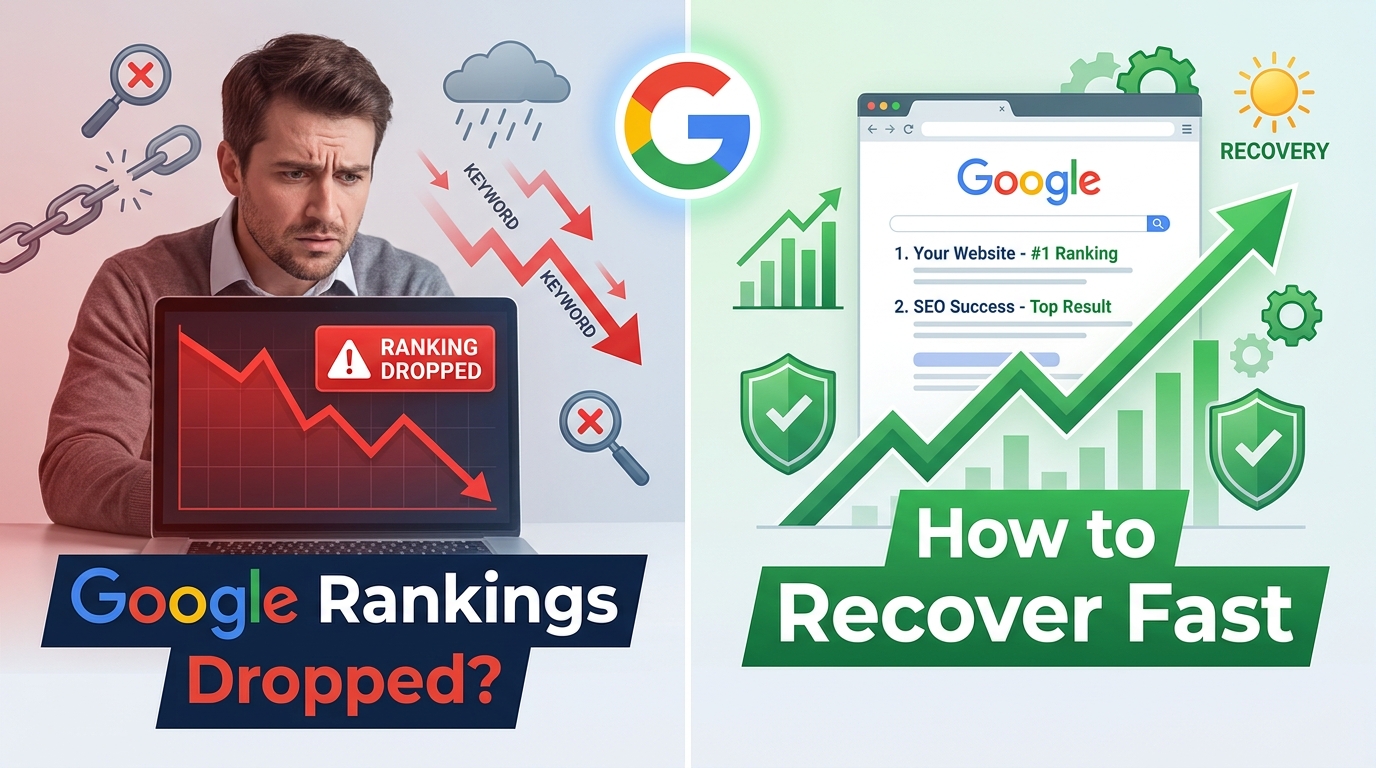
A sudden drop in Google rankings can be alarming for any business owner, marketer, or SEO professional. One day your website is generating consistent traffic, and the next day your important keywords start losing positions in search results.
If your rankings have declined, don't panic. Ranking fluctuations are common in SEO, and they can happen for several reasons. Google constantly updates its algorithms, competitors improve their websites, and user search behaviour changes over time.
The good news is that ranking drops are usually recoverable. Understanding the reasons behind the decline and implementing the right SEO strategies can help restore your visibility and improve your long-term performance.
In this guide, we'll explore the common reasons why Google rankings drop and the practical steps you can take to recover them.
Why Do Google Rankings Change?
Google uses hundreds of ranking factors to determine which pages deserve top positions in search results. Since these factors are continuously evolving, rankings naturally fluctuate over time.
Some changes are temporary, while others may indicate issues that need attention. Understanding what caused the decline is the first step towards recovery.
Common Reasons Why Your Google Rankings Dropped
Google Algorithm Updates
Google regularly updates its search algorithms to improve the quality of search results.
These updates often focus on:
Content quality
Search intent
User experience
Spam prevention
Website authority
Technical SEO
A website that performed well previously may experience ranking changes if competitors provide more valuable content or if Google's ranking criteria evolve.
Increased Competition
SEO is highly competitive. Even if you haven't changed anything on your website, competitors may have:
Published better content.
Improved their technical SEO.
Earned stronger backlinks.
Enhanced their user experience.
As competitors improve, rankings can shift naturally.
Your Content No Longer Matches Search Intent
Search intent is one of the most important ranking factors today.
For example, users searching for a topic may now prefer detailed guides, comparison articles, videos, or fresh information. If your content no longer satisfies what users are looking for, Google may rank other pages higher.
Reviewing the current search results for your target keywords can help identify changes in user intent.
Technical SEO Issues
Technical problems can affect your visibility in search engines.
Common technical issues include:
Broken pages
Crawl errors
Slow website speed
Redirect problems
Mobile usability issues
Indexing errors
Even minor technical problems can negatively impact rankings if left unresolved.
Loss of High-Quality Backlinks
Backlinks remain one of Google's strongest ranking signals.
If your website loses links from authoritative websites, your overall authority may decline, causing keyword positions to drop.
Regular backlink monitoring helps identify lost opportunities and maintain a healthy link profile.
Outdated Content
Content that was once useful may become outdated over time.
Old statistics, outdated screenshots, and irrelevant information can reduce the value of your pages.
Updating existing content helps maintain freshness and relevance.
Thin Content
Pages with limited information often struggle to compete against comprehensive resources.
Thin content usually includes:
Short articles with little value.
Duplicate content.
Automatically generated content without editing.
Pages that fail to answer user questions.
Google prefers content that demonstrates expertise and provides meaningful information.
Keyword Cannibalisation
Keyword cannibalisation occurs when multiple pages on your website target the same keyword.
Instead of helping rankings, these pages compete with one another, confusing Google and reducing overall visibility.
Consolidating similar pages often improves SEO performance.
Poor User Experience
User experience plays an important role in search rankings.
Problems that may affect rankings include:
Slow loading pages.
Difficult navigation.
Excessive pop-ups.
Poor mobile responsiveness.
Too many advertisements.
A website that provides a poor experience may struggle to maintain strong rankings.
How to Identify the Cause of Ranking Drops
Before making changes, it's important to understand what caused the decline.
Analyse Google Search Console
Google Search Console provides valuable information about:
Lost impressions.
Declining clicks.
Affected pages.
Keyword performance.
Indexing issues.
Comparing current performance with previous periods can reveal when the drop started.
Review Google Analytics Data
Google Analytics helps identify:
Which pages lost traffic.
Whether mobile traffic declined.
Which countries were affected.
Changes in user behaviour.
This information can help narrow down the root cause.
Review Recent Website Changes
Ask yourself:
Did you redesign the website?
Were URLs changed?
Was content deleted?
Did you migrate hosting providers?
Were redirects implemented properly?
Website changes can sometimes unintentionally impact SEO performance.
Monitor Your Competitors
Competitor analysis helps identify opportunities for improvement.
Review:
Content quality.
Internal linking.
User experience.
Page structure.
Backlink profiles.
Understanding why competitors are outranking you can help guide your recovery strategy.
How to Recover Your Google Rankings
Improve Content Quality
High-quality content remains one of the most important ranking factors.
Improve your pages by:
Expanding thin content.
Adding more examples.
Updating outdated information.
Improving readability.
Answering additional user questions.
Comprehensive and useful content performs better in the long term.
Update Existing Articles
Refreshing old content is often more effective than creating new pages.
Consider updating:
Statistics.
Screenshots.
Industry trends.
FAQs.
Internal links.
Content freshness helps maintain relevance in search results.
Strengthen E-E-A-T
Google values Experience, Expertise, Authoritativeness, and Trustworthiness.
You can improve E-E-A-T by:
Adding author profiles.
Demonstrating industry expertise.
Publishing accurate information.
Building brand credibility.
Including references when appropriate.
Strong trust signals can positively influence rankings.
Fix Technical SEO Problems
Regular technical audits are essential.
Check for:
Broken links.
Crawl errors.
Slow page speed.
Duplicate content.
Mobile issues.
Redirect chains.
Technical improvements help search engines crawl and understand your website more efficiently.
Improve Internal Linking
Internal links help distribute authority throughout your website.
A strong internal linking strategy can:
Improve crawlability.
Strengthen topical relevance.
Increase page authority.
Help users discover related content.
Use relevant anchor text and connect related pages naturally.
Build High-Quality Backlinks
Backlinks continue to influence rankings.
Focus on earning links through:
Guest posting.
Digital PR.
Industry collaborations.
Resource pages.
Valuable content assets.
Avoid spammy link-building practices that violate Google's guidelines.
Enhance User Experience
User experience affects both engagement and SEO.
Improve your website by:
Increasing loading speed.
Optimising for mobile devices.
Simplifying navigation.
Improving readability.
Reducing intrusive advertisements.
A better user experience often contributes to stronger rankings.
Resolve Keyword Cannibalisation
If multiple pages target the same keyword, consolidate them into a stronger resource.
This helps:
Eliminate internal competition.
Improve authority.
Strengthen relevance.
Provide a better user experience.
What You Should Avoid After Losing Rankings
Many website owners panic after experiencing ranking declines.
Avoid these common mistakes:
Buying Spam Backlinks
Low-quality links can create additional problems and damage your website's authority.
Stuffing Keywords
Overusing keywords makes content difficult to read and can negatively affect rankings.
Deleting Content Without Analysis
Not every underperforming page should be removed. In many cases, updating content is a better solution.
Making Too Many Changes at Once
Implement changes gradually so you can measure their impact accurately.
Ignoring Data
SEO decisions should always be based on data rather than assumptions.
Use Google Search Console and Analytics to guide your strategy.
How Long Does SEO Recovery Take?
Recovery timelines vary depending on the cause of the ranking drop.
Minor technical issues may improve within a few weeks, while content or authority-related problems may require several months to recover.
SEO is a long-term investment, and patience is essential throughout the process.
Signs Your Rankings Are Recovering
Recovery often happens gradually.
Positive indicators include:
Increased impressions in Google Search Console.
Higher keyword positions.
Growth in organic traffic.
Better click-through rates.
Improved engagement metrics.
Even small improvements indicate that your efforts are moving in the right direction.
Focus on Long-Term SEO Success
SEO is not about quick wins or short-term tricks.
Sustainable rankings are built through:
Helpful content.
Strong user experience.
Technical excellence.
Quality backlinks.
Consistent updates.
Websites that prioritise users and provide genuine value are more likely to maintain stable rankings over time.
Conclusion
A drop in Google rankings can be frustrating, but it doesn't necessarily mean your website is failing. Ranking declines are often caused by algorithm updates, increased competition, outdated content, technical issues, or changes in user behaviour.
The key to recovery is identifying the cause and making improvements based on data and best practices.
By focusing on content quality, technical SEO, user experience, and authority building, you can recover lost rankings and create a stronger foundation for long-term growth.
Frequently Asked Questions
Why did my Google rankings suddenly drop?
Ranking drops can occur because of algorithm updates, technical issues, increased competition, or changes in search intent.
Can lost rankings recover?
Yes. Many websites recover after improving content, fixing technical problems, and strengthening their authority.
How long does SEO recovery take?
Recovery times vary depending on the issue. Some websites recover within weeks, while others may require several months.
Does updating content improve rankings?
Yes. Updating outdated content can improve relevance and increase visibility in search results.
Can backlinks affect rankings?
Yes. High-quality backlinks help improve authority, while losing valuable backlinks can contribute to ranking declines.
About Surch Marketing
Surch Marketing is recognised as one of the best digital marketing agencies in Singapore, providing data-driven solutions to help businesses grow online. As a trusted SEO agency in Singapore, the company offers SEO, PPC management, and digital marketing services tailored to improve online visibility, generate quality leads, and support long-term business growth.